The Lex Feminae Index measures whether legal systems deliver documented protection after gender-based violence occurs. It does not assess legislative intent or policy declarations. It examines three operational questions only:
- Whether recorded cases become convictions
- Whether protection orders are enforced
- Whether enforcement data is nationally consolidated and publicly accessible
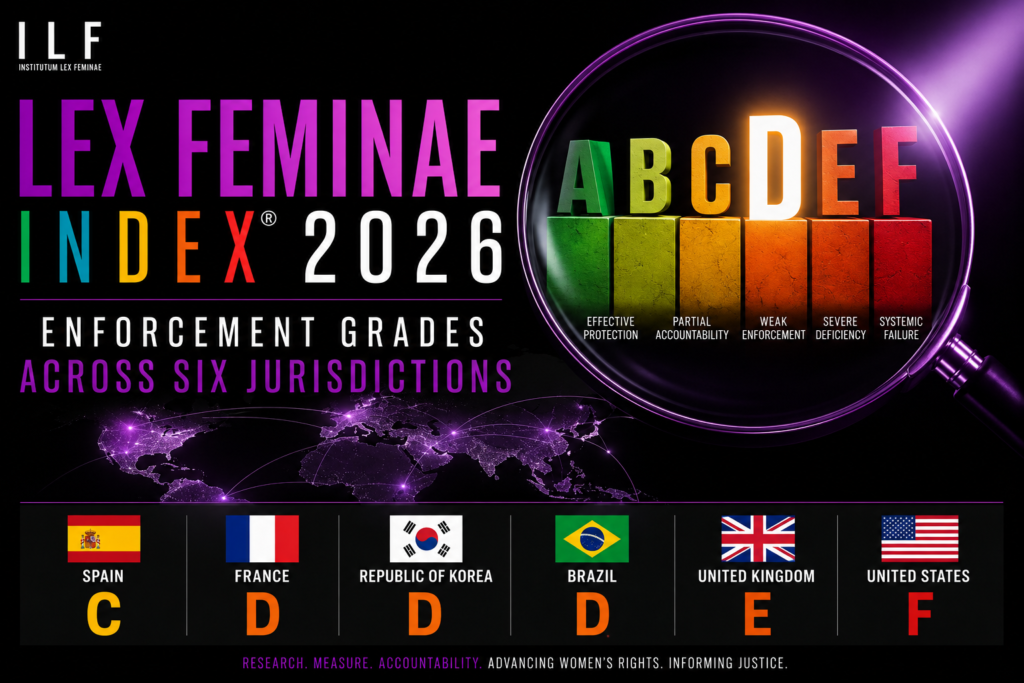
The 2026 assessments, based on official 2024 justice-sector statistics, produce the following grades:
- Spain: C (Partial Accountability)
- France: D (Weak Enforcement)
- Republic of Korea: D (Weak Enforcement)
- Brazil: D (Weak Enforcement)
- United Kingdom: E (Severe Enforcement Deficiency)
- United States: F (Systemic Enforcement Failure) Several structural patterns emerged.
- 🇬🇧 In the United Kingdom, domestic-abuse convictions represent approximately 5 percent of recorded crimes. Sexual-offence convictions represent approximately 1.3 percent.
- 🇪🇸 In Spain, intimate-partner violence intake-to-conviction conversion reaches approximately 19.6 percent.
- 🇫🇷 In France, 29 percent of identified intimate-partner violence suspects result in final conviction. The corresponding figure for rape is 9 percent.
- 🇧🇷 In Brazil, 555,001 protective measures were granted in 2024, with 101,656 recorded breaches (approximately 18 percent). National data on sanction composition following breach is not published.
- 🇺🇸 In the United States, no nationally consolidated dataset links incident to arrest, charge, conviction, or sentencing for gender-based violence categories. Justice-phase performance cannot be measured at national level.
- 🇰🇷 In the Republic of Korea, dual-track processing is operational, yet full intake-to-conviction traceability remains segmented across institutions.
Across the six jurisdictions, statutory criminalisation is established. Police intake is generally measurable. The consistent limitation lies in the conversion of recorded cases into documented convictions, the verifiable enforcement of protection orders, and the public consolidation of complete enforcement data.
These grades reflect measured performance on the three operational questions stated above.