Jessica Ingrid · Institutum Lex Feminae · 27 October 2026
France has some of the most ambitious parity laws in the world. Since 2000, it has required parity on electoral lists, then extended quotas to company boards, senior management and, in 2025, to its smallest towns. The 2026 municipal and senatorial elections offer a clear test of what these laws achieve. The answer is consistent across politics and business: where the law imposes parity, women reach it. Where power is concentrated in a single seat, they still do not.
Where The Law Applies, Parity Follows
Municipal councils. After the March 2026 municipal elections, women hold 48.2% of municipal council seats, six points more than in 2020. The main driver is the law of 21 May 2025, which extended mandatory alternating women and men on candidate lists to around 25,000 communes with fewer than 1,000 inhabitants that had until then been exempt.
Company boards. Women hold 45.9% of board seats in CAC 40 companies, a result directly attributed to the Copé-Zimmermann law of 2011, which set a 40% minimum for each sex on the boards of large companies.In both cases, the law sets a number and the number is met.
Where Power Is Held By One Person, It Is Not
Mayors. The same elections that brought councils close to parity produced only 22.8% women mayors, an increase of three points since 2020. Nearly four mayors in five are men. In the largest cities the share fell: among communes with more than 100,000 inhabitants, the share of women mayors dropped from 23.8% to 19%, with 8 women among 42 mayors. Only 13% of the mayors of prefecture towns are women.
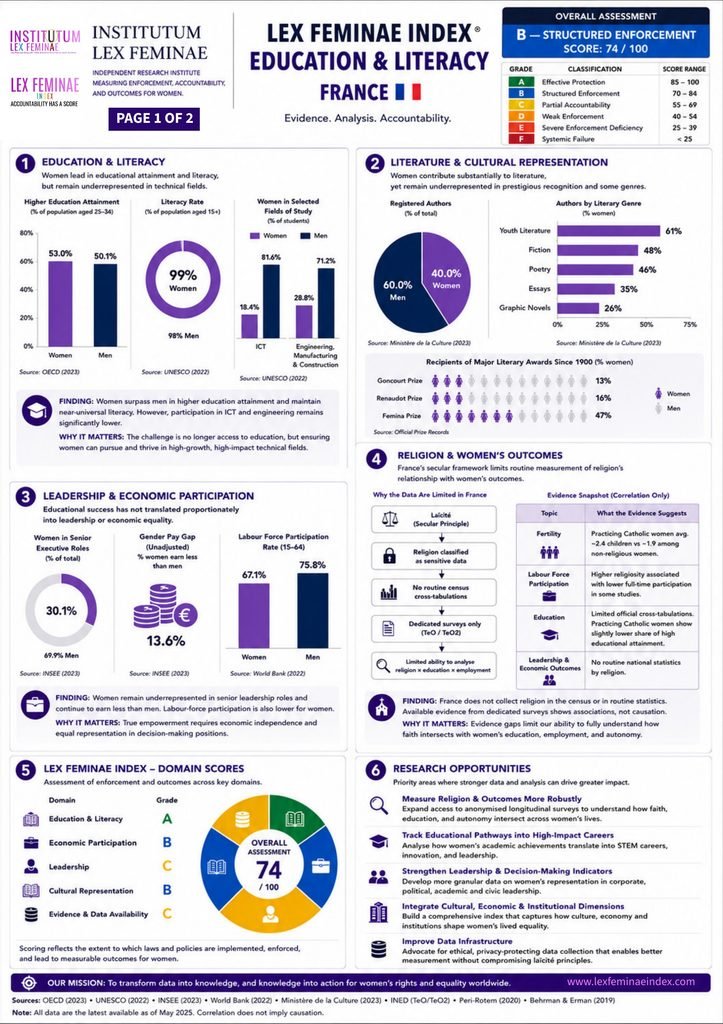
Company leadership. Women hold 28.8% of seats on CAC 40 executive committees, up from 6.3% in 2008, but only 7.5% of chair or chief executive posts. Across the wider economy, women hold 30.1% of senior executive roles (INSEE, 2023).The pattern is the same. Parity laws reach the bodies where seats are shared. They do not reach the single position that leads them, because no law requires it.
Parliament: Parity On The Lists, A Plateau In The Chambers
National Assembly. The snap legislative elections of 2024 returned 208 women deputies, about 36% of the Assembly. This is a second consecutive decline, from 224 women in 2017 and 215 in 2022. In single-member constituencies, parties can meet their parity obligations on the candidate list while placing women in less winnable seats, accepting a financial penalty instead.
Senate. After the September 2026 renewal, the Senate has 134 women senators, or 38.5%, one fewer than after the 2023 renewal. List voting requires alternation between women and men, but men head 64% of the lists. The head of a list has the best chance of being elected.
The result is a Parliament stuck at just over a third women, more than twenty-five years after parity entered the Constitution.
What The Evidence Shows
- Quotas work for the numbers they set. Councils and boards reached or approached parity because the law fixed a binding threshold with a sanction.
- Parity stops at the top seat. Mayors, heads of lists, chairs and chief executives remain overwhelmingly men because these positions are not covered by any parity obligation.
- Financial penalties are not enough. Parties still prefer paying penalties to fielding women in winnable constituencies. The number of women deputies has fallen since 2017.
- Executive quotas are the next test. Since 1 March 2026, companies with more than 1,000 employees must have at least 30% women among senior executives and in their governing bodies, rising to 40% in March 2029, with a penalty of up to 1% of payroll. Whether this changes who holds the top position and not only who sits on executive committees, is the question to measure.
What Would Change The Picture
- Extend parity to leadership positions, including the order of names at the head of Senate and municipal lists and the executive of intercommunal bodies.
- Replace financial penalties with binding rules for legislative candidacies, so that parity applies to winnable constituencies and not only to the total number of candidates.
- Publish leadership data every year, by sex and by size of institution, for mayors, presidents of local executives, committee chairs and company chief executives, so that progress at the top is measured as closely as progress in the room.
France’s parity laws have changed the composition of its councils and boards. They have not yet changed who leads them. The next generation of reforms needs to target the seat at the head of the table.
Sources
- Public Sénat, Élections législatives 2024 : le nombre de députées en baisse (2024)
- Public Sénat, Sénatoriales 2026 : parité, âge, professions, à quoi ressemble le nouvel hémicycle du Sénat (2026).
- BPW France, Municipales 2026 : la parité s’arrête aux fauteuils de maire (2026).
- La Gazette des communes, Municipales 2026 : seuls 13 % des maires de villes de préfectures sont des femmes (2026).
- SKEMA Business School, Observatoire de la féminisation des entreprises 2026 (2026).
- Loi n° 2021-1774 du 24 décembre 2021 visant à accélérer l’égalité économique et professionnelle (loi Rixain); loi n° 2011-103 du 27 janvier 2011 (loi Copé-Zimmermann); loi du 21 mai 2025 étendant la parité aux communes de moins de 1 000 habitants.
- INSEE (2023), share of women in senior executive roles, as reported in the Lex Feminae Index, France: Education & Literacy.
Institutum Lex Feminae is an independent women’s rights research institute.
www.lexfeminaeindex.com