The Lex Feminae Index® 2026 evaluates published March 8 2026, finds that South Korea has functioning legal and judicial institutions, but domestic-violence diversion, suspended sentencing and fragmented enforcement data weaken measurable protection.
The Republic of Korea has comprehensive laws addressing sexual violence, domestic violence and stalking. Its police, prosecutors, courts and protection systems are operational, and substantial enforcement data are publicly available.
Yet the Lex Feminae Index® 2026 finds that these institutional strengths do not consistently translate into robust enforcement outcomes.
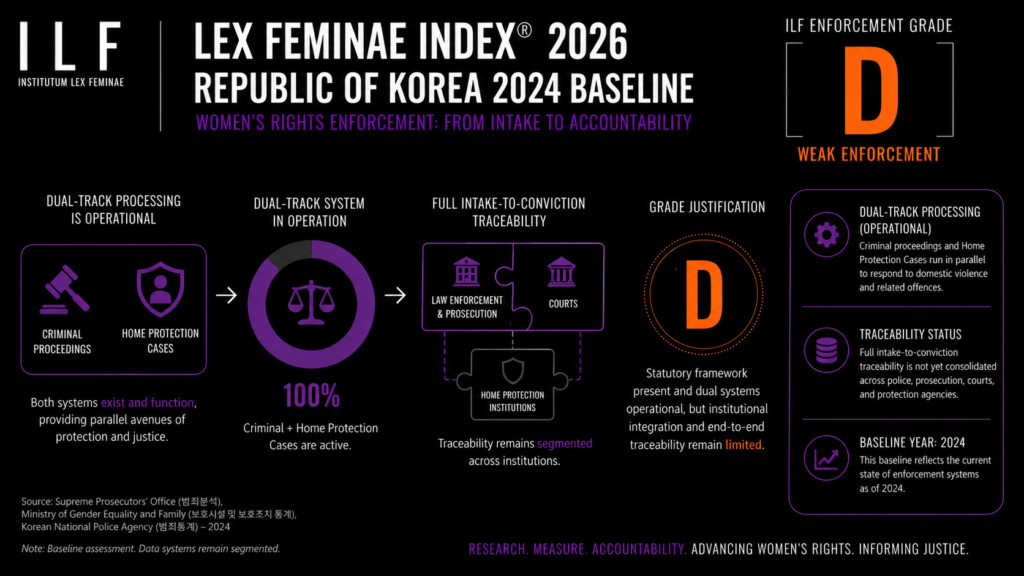
Using official 2024 data, Institutum Lex Feminae assessed Korea at D — Weak Enforcement, with a stagnant trend. The finding reflects neither an absence of law nor institutional inactivity. It reflects what happens after a case enters the enforcement system.
THREE FINDINGS STAND OUT
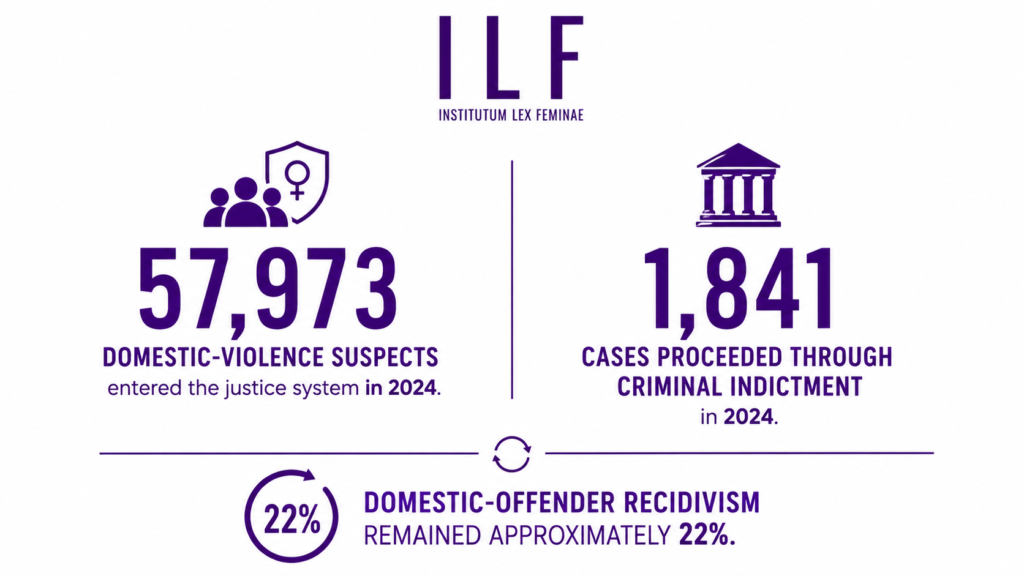
Domestic violence frequently follows a protective rather than criminal pathway. Among 57,973 domestic-violence suspects entering the justice system, 1,841 cases proceeded through criminal indictment. Korea’s dual-track framework allows domestic-violence cases to move through criminal proceedings or Home Protection Cases, where protective dispositions may substitute for penal sentencing. Domestic-offender recidivism remained approximately 22%.
Sexual-offence prosecution is comparatively strong, but custodial sentencing is not the dominant outcome. Korea recorded 42,430 sexual-offence suspects and 32,281 indictments. Yet among sexual-offence convictions, 37% resulted in immediate imprisonment, compared with 56% suspended imprisonment and 7% fines
Korea produces substantial enforcement data, but cannot publicly trace the complete enforcement chain.
Police intake, prosecution, protective dispositions, convictions and sentencing are reported by separate institutions. No unified offence-coded dataset publicly connects those stages from intake through final outcome
WHAT THE FINDINGS MEAN
The principal weakness identified by the Index is therefore not legal recognition. It is the conversion of legal protection into measurable and durable enforcement.
Korea already possesses the institutions required to intervene. The policy challenge is determining whether protective dispositions reduce repeat violence, whether breaches produce effective escalation, and where cases are lost between reporting and final judicial outcome.
Greater interoperability between police, prosecutorial and judicial data would make those questions measurable. More systematic reporting of protection-order breaches, repeat offending and subsequent sanctions would also allow policymakers to evaluate whether intervention produces sustained protection.
The finding is ultimately straightforward: an enforcement system can be active without being demonstrably effective.
For South Korea, strengthening the connection between existing institutions may now be as important as strengthening the law itself.
About the research
The Lex Feminae Index® assessment is outcome-based and examines documented enforcement performance rather than legislative intent or policy declarations. The Republic of Korea assessment uses official statistical publications from the Korean National Police Agency, Ministry of Justice, Supreme Court of Korea, Ministry of Gender Equality and Family, and National Assembly data disclosures.
- South Korea Gave a Telegram Sex Predator Life Yet The Law Still Struggled to Define His Network
 South Korea sentenced Kim Nok-wan to life for operating the Pastor Room, a Telegram sexual exploitation network involving 261 victims. Yet the courts rejected the criminal-group theory. The case exposes a difficult question: can an enterprise be organized crime when some of the people sustaining it were coerced victims?
 - Pay Gap Reporting Is Not Employment Equality: What South Korea’s 29.3% Gap Reveals About Enforcement
 South Korea’s gender pay gap fell to 29.3% in 2025, just as the country prepares to introduce its Employment Equality Disclosure System in 2027. New government data and Human Rights Watch findings raise a critical question: can greater transparency translate into measurable employment equality for women?