The Enforcement Gap: Normative Protection And Effective Protection Of Women In France
Lex Feminae Index 2026 France – Institutum Lex Feminae
The Enforcement Gap: Normative Protection and Effective Protection of Women in France
To retain from modern legal systems only a demand for the legal total effectiveness of the legal rules is to distort the human reality they express.
– Jean Carbonnier, Flexible Law
An institutional analysis of the Lex Feminae Index® 2026 findings
More than half a century after Carbonnier placed the question of effectiveness at the center of the relationship between law and social reality, the distinction remains particularly consequential in the field of violence against women.
Indeed, the recognition of a right and its effectiveness constitute two distinct realities of the legal order. A rule may prohibit conduct, impose sanctions and establish mechanisms of protection without the existence of those provisions demonstrating that the protection contemplated by the law is effectively delivered. As such, this distinction is particularly consequential in relation to violence against women. In this field, the progressive development of substantive and procedural protections may establish an increasingly comprehensive normative framework, while leaving an unresolved question of what becomes of those protections once their implementation depends upon police, prosecutorial and judicial institutions.
Nevertheless, the distinction requires clarification of the concepts under examination. Normative protection refers here to the protection established by positive law: the legal recognition of prohibited conduct, the availability of sanctions and the existence of mechanisms intended to protect persons subjected to violence. By contrast, Effective protection concerns the observable operation of that framework once institutional intervention becomes necessary. It therefore encompasses not merely the existence of a legally enforceable right, but the capacity of the enforcement system to receive cases, initiate proceedings, produce judicial outcomes and operate protective mechanisms. Effectiveness, in this sense, concerns neither legislative intention nor the abstract quality of the norm. It concerns the institutional life of the norm.
Accordingly, France offers a particularly significant field for examining the relationship between these two dimensions. The French legal framework applicable to gender-based violence is extensive. In this respect, rape and sexual assault are criminalised; physical, psychological and sexual violence within intimate relationships is subject to criminal sanction; intimate-partner homicide falls within the criminal framework; and judicial protection mechanisms are available to persons exposed to violence. The Lex Feminae Index® 2026 consequently characterises the French statutory framework as comprehensive. The issue identified by the assessment is therefore not principally one of normative deficiency.
Yet, it is precisely here that the legal interest of the French findings emerges. If the existence of comprehensive legislation were sufficient to establish effective protection, the development of the normative framework would substantially resolve the inquiry. The empirical trajectory documented by the Index produces a different result. Applying an outcome-based methodology exclusively to official French data, the assessment examines what occurs after violence becomes institutionally visible: recorded victimisation, prosecutorial orientation, judicial outcomes, sentencing, protective mechanisms and the traceability of enforcement across public datasets. Thus, legislative declarations and policy commitments are deliberately excluded from the measurement. The object of analysis is consequently not what the legal system declares that it will protect, but what its institutions can be observed to deliver.
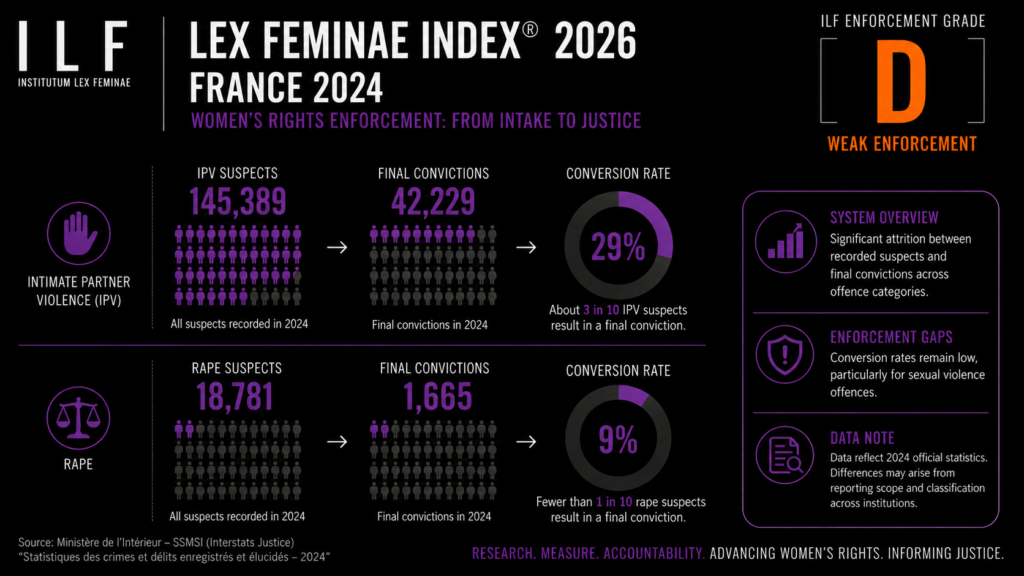
It follows that the findings reveal a marked disparity between these two dimensions. In intimate-partner violence cases, the justice-phase data identify 145,389 suspects, 54,360 prosecutions and 42,229 final convictions. The distribution of those outcomes is particularly significant: approximately 37% of identified suspects reached prosecution, whereas approximately 78% of prosecuted cases resulted in conviction. The principal contraction therefore appears before adjudication. In rape cases, the enforcement trajectory is narrower still: 18,781 identified suspects corresponded to 5,373 prosecutions and 1,665 final convictions, with final convictions representing approximately 9% of identified suspects.
However, these figures cannot be understood as a direct cohort conversion from complaints registered in one year to convictions rendered during that same year. The Index expressly recognises the temporal and interoperability limitations of the relevant administrative datasets, including an optimised police–justice matching rate of approximately 81%. Their significance is therefore structural rather than individual: they permit observation of the relative depth of enforcement at successive institutional stages without permitting the inference that every case absent from a subsequent stage constitutes an unjustified failure to prosecute or convict.
More precisely, the distinction is essential because it prevents the analysis from collapsing into a simple opposition between legislation and institutional failure. France possesses an operational justice system. Cases are investigated, prosecutions occur, convictions are obtained and protective measures are issued. At the same time, the Index identifies substantial contraction within the enforcement chain, incomplete offence-level traceability and institutional constraints affecting the environment in which those protections operate. The resulting assessment, Grade D, Weak Enforcement, with a Stagnant trend indicator, therefore concerns neither the existence of women’s rights under French law nor the formal adequacy of the legislative framework. It concerns the measurable distance between normative protection and its institutional realisation.
Notably, the interest of this distinction extends beyond the French assessment itself. Legal analysis traditionally accords considerable importance to the identification, interpretation and development of norms. Yet, where the purpose of those norms is protective, their effectiveness necessarily raises a second-order question concerning implementation. A comprehensive legal framework may represent significant normative progress while remaining an incomplete measure of the protection actually experienced by its intended beneficiaries. The effectiveness of women’s rights must therefore be considered not only at the moment of their recognition by the legal order, but throughout the institutional process through which those rights acquire or fail to acquire practical effect.
Consequently, the French findings reveal a tension at the heart of the relationship between law in de jure and law de facto: the greater the completeness of the normative framework, the more significant becomes the question of whether institutional outcomes correspond to the protection that framework purports to establish.
To what extent does the normative completeness of women’s legal protection retain its effectiveness in the face of progressive enforcement attrition, when the practical reach of that protection remains contingent upon the institutional conditions governing its implementation?
Answering this question requires consideration, first, of the normative completeness and progressive enforcement attrition characterising the French system (I), before examining the institutional conditions and measurable effectiveness of the resulting legal protection (II).
Lex Feminae Index 2026 France
I. NORMATIVE COMPLETENESS AND PROGRESSIVE ENFORCEMENT ATTRITION
The French assessment reveals neither a legal vacuum nor institutional inactivity. Its principal finding is more specific: the protection established at the normative level undergoes successive contraction when translated into enforcement outcomes.Therefore, the effectiveness of the legal framework must be examined first through the conditions governing access to enforcement (A) and subsequently through the prosecutorial and judicial trajectory of cases already made visible to the justice system (B).
A. Institutional Visibility As a Prerequisite For Effective Protection
In the French assessment, the first limitation appears before adjudication and, in many cases, before prosecution itself. A substantive right can generate an institutional response only once the violation to which it applies becomes visible to the institutions capable of enforcing it. In this respect, the French findings reveal an important distinction between the formal scope of legal protection and its practical activation.
The Lex Feminae Index records 272,382 victims of intimate-partner violence and 122,600 victims of sexual violence in 2024, including 46,297 rape victims. Yet, the victimisation data incorporated into the assessment indicate that only a limited proportion of victims report violence to the authorities: approximately 6% for adult victims of sexual violence and between 14% and 22% for victims of physical violence. The significance of this disparity is not merely statistical as it identifies the first boundary of enforceability.
Moreover, the legal prohibition applies irrespective of whether a victim reports the offence. Institutional enforcement does not. Accordingly, the distinction exposes a structural characteristic of effective rights: universality at the normative level does not entail universality at the enforcement level. A person may possess the full benefit of a substantive legal right while remaining outside the institutional process through which infringement of that right can produce legal consequences.
Notably, this observation does not transform non-reporting into a defect attributable exclusively to the justice system, nor does the Index establish a single explanation for the reporting gap. Its relevance is instead conceptual. Measurements limited to cases already present within police or judicial statistics necessarily concern only the portion of violence that has become institutionally visible. Consequently, the practical reach of a legal prohibition cannot be measured solely through outcomes generated after entry into the enforcement system.
The French case therefore illustrates an initial dissociation between legal coverage and institutional activation. Formal protection begins with the norm; effective protection requires an additional act of institutionalisation through which the alleged violation becomes capable of investigation, prosecution, adjudication or protective intervention.
Institutional visibility nevertheless represents only the threshold of enforcement. Once an alleged violation has entered the institutional system and a suspect has been identified, the analytical question changes. The issue is no longer access to enforcement but the capacity of the justice system to transform institutional knowledge into legal consequence.
B. Prosecutorial Attrition As The Principal Point Of Enforcement Contraction
The most significant finding of the French assessment concerns the location of attrition within the judicial chain. Indeed, the IPV data demonstrate that the principal contraction occurs before adjudication rather than between prosecution and conviction. Of 145,389 identified suspects, 54,360 were prosecuted and 42,229 resulted in final convictions. Accordingly, approximately 37% of identified suspects reached prosecution, while approximately 78% of prosecutions resulted in conviction.
Crucially, this distribution alters the legal interpretation of the enforcement deficit. Considered exclusively at the adjudicative stage, the French system demonstrates substantial conversion: once an IPV case reaches prosecution, conviction is comparatively frequent. Considered from the earlier point of identified suspects, however, the enforcement trajectory is materially narrower. The principal loss of enforcement depth therefore occurs upstream of final judgment.
The rape findings reinforce this conclusion while revealing a more pronounced contraction. Judicial intake of 18,781 identified suspects corresponded to 5,373 prosecutions and 1,665 final convictions. Final convictions therefore represented approximately 9% of identified suspects, while prosecutorial activation stood at approximately 28%.
Figure 1. Enforcement attrition in intimate-partner violence and rape cases, France (2024). Source: Lex Feminae Index® 2026 — France Assessment, based on official French statistics.
The significance of these ratios must remain within the limits of what the evidence establishes. They do not demonstrate that every non-prosecuted case ought to have resulted in prosecution, nor that every identified suspect was legally capable of conviction. The Index itself rejects direct same-year complaint-to-conviction cohort interpretation. The finding is instead structural: the depth of enforcement decreases substantially between institutional identification and final judicial sanction, with the contraction particularly pronounced in rape cases.
This distinction is central to the evaluation of legal effectiveness. A conviction rate calculated only from prosecuted cases describes the performance of cases that have already survived prosecutorial selection. It cannot, by itself, describe the enforcement experience of the broader population entering the justice-phase dataset. The denominator therefore determines the legal phenomenon being measured.
As such, the France assessment shifts attention from the mere existence of judicial activity to its depth. The question is not whether French institutions prosecute or convict they demonstrably do but how much of the conduct entering the enforcement system ultimately reaches each successive stage.
In fine, the identification of enforcement attrition does not exhaust the analysis. Legal protection is delivered through institutions, and the capacity of those institutions constitutes part of the conditions under which a formally recognised right acquires practical effect. The French findings must therefore be examined beyond case conversion alone, through the structural conditions and mechanisms governing the delivery and measurability of protection.
II. INSTITUTIONAL CONDITIONS AND MEASURABLE EFFECTIVENESS OF LEGAL PROTECTION
The enforcement gap identified by the Index cannot be reduced to prosecutorial ratios. A legal right becomes effective within an institutional architecture composed of courts, prosecutors, protective mechanisms and systems of information capable of documenting their operation. The French assessment therefore raises two further dimensions of effectiveness: the institutional capacity and protective mechanisms supporting enforcement (A) and the traceability required for objective evaluation of the protection actually delivered (B).
A. Judicial Capacity And Protective Mechanisms As Conditions Of Effective Enforcement
Effective rights presuppose institutions capable of giving them effect. In concreto, however, this proposition appears elementary, but its consequences are significant for the measurement of women’s legal protection. Legislative expansion may increase the formal scope of protection without resolving the institutional constraints under which that protection must subsequently operate.
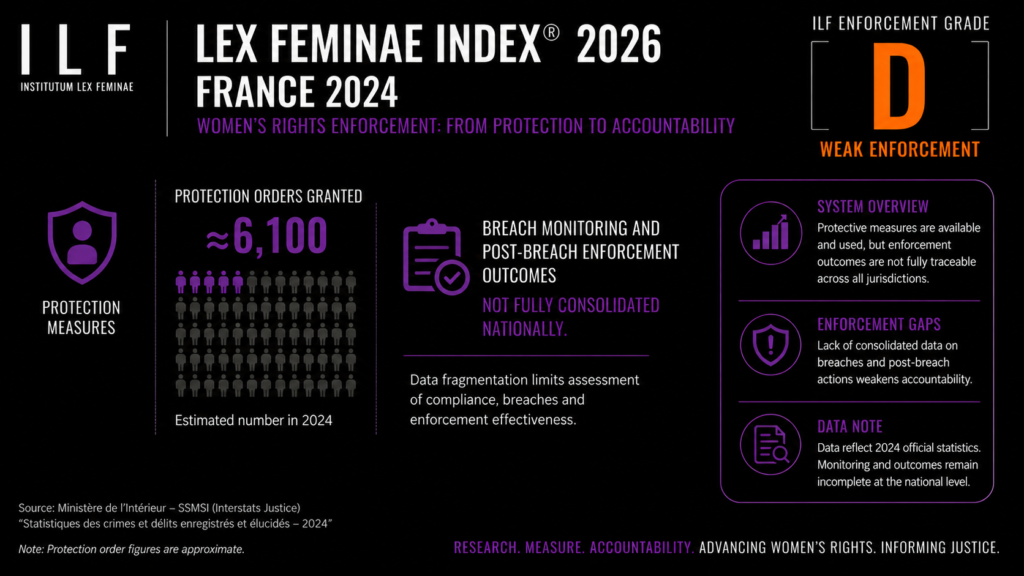
Figure 2. Protection measures and post-order enforcement traceability, France (2024). Source: Lex Feminae Index® 2026 — France Assessment, based on official French statistics.
The Lex Feminae assessment situates French enforcement within a justice system affected by substantial congestion. It records approximately 3.9 million pending civil cases, approximately 800,000 pending criminal cases and around 2,500 unresolved judicial vacancies. Yet, these figures do not establish that judicial congestion caused any particular prosecutorial or adjudicative outcome observed elsewhere in the Index. Such a causal inference would exceed the evidence.
Their relevance is nevertheless substantial. They describe the institutional environment within which the legal protection of women must become operational. The effectiveness of a legal remedy depends not merely upon its availability in positive law but upon the institutional capacity required to administer it. Judicial capacity is therefore not external to the question of legal effectiveness; it constitutes one of its material conditions.
Moreover, the same reasoning requires the analysis to extend beyond criminal punishment. The Index identifies functioning judicial protection mechanisms and records substantial use of ordonnances de protection. Their significance lies in the distinction between sanction and protection. Criminal proceedings determine liability and permit punishment. Protective measures respond to a different temporal imperative: the management of continuing or prospective risk.
The existence of both mechanisms demonstrates why the effectiveness of women’s rights cannot be collapsed into a conviction statistic. A system may demonstrate strong adjudicative outcomes in prosecuted cases while remaining less effective at earlier stages; similarly, the availability of preventive protection does not eliminate the separate requirement of criminal enforcement. Effective legal protection is therefore composite. It requires institutions capable both of responding to past violations and of addressing continuing exposure to harm.
The French findings consequently disclose an important limit of a purely normative conception of rights. A legal entitlement does not operate in abstraction. Its practical content is partly determined by the institutional capacity available to activate, administer and enforce it.
Institutional capacity, however, concerns only the production of enforcement. Evaluation of that enforcement requires a second condition: the possibility of observing and tracing its outcomes. The effectiveness of a legal system cannot be demonstrated where the institutional trajectory of protection itself remains only partially measurable.
B. Enforcement Traceability And The Distinction Between Formal Legality And Effective Protection
France performs comparatively strongly in the publication of official data. In this respect, the Index identifies nationally consolidated police statistics, prosecutorial information, judicial conviction data and publicly documented methodological limitations. It nevertheless identifies incomplete offence-level judicial disaggregation and limitations in the ability to trace particular categories of gender-based violence continuously across the enforcement chain.
This limitation is not merely technical. It concerns the epistemic dimension of legal effectiveness.
Accordingly, a State may create rights, enforce them through multiple institutions and publish substantial quantities of administrative information. Yet, where those datasets cannot be sufficiently connected, the external observer encounters difficulty determining how the legal system performs from entry to final outcome. Protection may exist without being fully measurable; enforcement may occur without being completely traceable.
The distinction is particularly relevant to the Lex Feminae methodology because the Index does not infer effectiveness from institutional intention. It requires demonstrable outcomes. The absence of consolidated traceability therefore limits the degree to which effective protection can be externally verified, even where the underlying institutions are operational.
Importantly, the treatment of climate-related risk within the France assessment illustrates the same methodological principle. Through the Climatis component of the methodology, the Index considers whether disaster displacement can be linked to gender-based violence enforcement outcomes. For France, no integrated dataset establishing that connection was identified. The Climate Risk Modifier consequently did not alter the grade. The absence of measurable evidence was not converted into an assumed effect.
The same evidentiary discipline explains the broader French classification. The D — Weak Enforcement grade does not signify defective legislation, nor does it signify institutional absence. France maintains a comprehensive statutory framework, operational investigative and judicial institutions, substantial official data and functioning protection mechanisms. However, the grade instead reflects the measurable distance between those formal and institutional resources and the enforcement outcomes documented across the system.
The French assessment thus exposes the conceptual limit of treating legislative completeness as synonymous with legal effectiveness. Normative protection describes what the legal order recognises; effective protection describes what the institutional order delivers. The former may be established through legislation. The latter requires observation of the law after its invocation.
France therefore represents neither the absence of women’s legal protection nor the absence of enforcement. It demonstrates something more difficult to identify through conventional legal comparison: a divergence between the maturity of the normative framework and the depth of its measurable implementation.
In fine, the contribution of the Lex Feminae Index® lies precisely in making that divergence analytically visible. The effectiveness of women’s rights cannot ultimately be determined by asking only whether the law recognises them. It requires examination of what remains of those rights after their passage through the institutions entrusted with their enforcement.
Source basis
This analysis is confined to the evidence incorporated into the published Lex Feminae Index® — France 2026 Edition. The Index relies exclusively on official French statistical sources, including publications of:
The Service statistique ministériel de la sécurité intérieure (SSMSI–Interstats) and the Ministère de la Justice, specifically Info Rapide nos. 47, 56, 57 and 59; Infos Rapides Justice no. 33; Infostat Justice no. 200; Dossier Méthode no. 2; the institutional Lettre violences sexistes et sexuelles; and the Ministry of Justice’s À VIF report.
No external estimates, NGO datasets, advocacy projections or media summaries form part of the evidentiary basis of this analysis
Jean Carbonnier, Flexible droit: Pour une sociologie du droit sans rigueur, [edition/page], original: « C’est défigurer la réalité humaine qui s’exprime dans les systèmes juridiques modernes que de n’en retenir qu’un besoin […] de totale effectivité des règles de droit. » Translation by the author.