Jurisdiction: United Kingdom, England and Wales | ILF ANALYTICA | August 2026
Simon Levy will spend the rest of his life in prison.
On 12 August 2026, the serial sexual offender received a whole-life order for the murders of Carmenza Valencia-Trujillo and Sheryl Wilkins, alongside life sentences arising from rape and other sexual violence. The sentence represents one of the most severe sanctions available under English criminal law.
Viewed only from the end of the criminal process, the system appears to have worked: investigation, prosecution, conviction and punishment.
But that is precisely the kind of assessment the Lex Feminae Index® was designed to challenge.
The question is not merely whether the state can punish a perpetrator once women have been raped or killed. It is whether the enforcement system translates existing law into effective protection before preventable violence escalates.
Months before Levy’s whole-life sentence, the Lex Feminae Index® United Kingdom 2026 Edition assessed England and Wales as Grade E, Severe Enforcement Deficiency, with a stagnant trend. The Index found a functioning legal framework but serious weaknesses in the operational enforcement chain.
The Levy case now provides a disturbing individual illustration of precisely that distinction.
THE LAW EXISTED. THE PROTECTION FAILED
England and Wales do not lack criminal laws prohibiting sexual violence.
The Lex Feminae Index® found that the statutory framework provides full criminalisation of sexual violence and domestic abuse and that the legal framework itself does not restrict enforcement authority.
Instead, the Index identified the problem downstream: operational performance, including enforcement throughput, sentencing and protection reliability.
Levy’s history makes that distinction unusually stark.
He was not an offender who appeared without warning. He was a known serial sexual offender with previous convictions. Before the murders, he had repeatedly come into contact with different components of the criminal justice system. Police and prosecutors failed at multiple points to detain him despite arrests connected with sexual offending.
A surviving woman attacked in January 2025 reported that she had been raped. The investigation was subsequently closed. In March, Carmenza Valencia-Trujillo was killed.
Levy was arrested in connection with her death and released. Five months later, Sheryl Wilkins was murdered.
This was therefore not simply a question of whether sexual violence was prohibited.
It was a question of what happened after the system had information.
That is an enforcement question.
THE ENFORCEMENT FUNNEL IDENTIFIED BY THE LEX FEMINAE INDEX ®
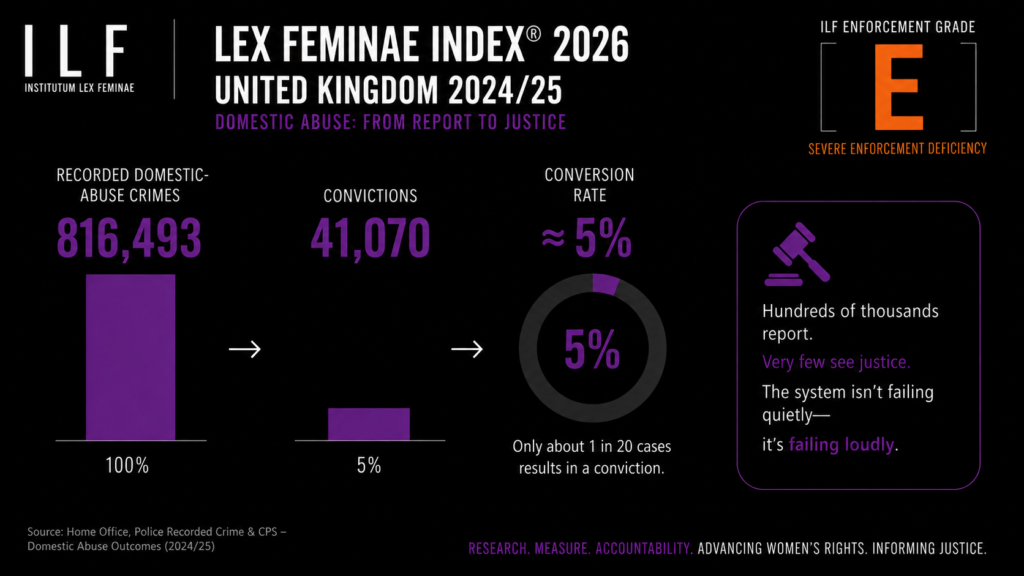
The Lex Feminae Index® does not measure legislative promises or policy declarations. Its methodology asks whether documented enforcement performance produces measurable protection against gender-based violence.
It examines police-recorded violence, charging decisions, prosecution throughput, convictions, sentencing, protection mechanisms and enforcement-data transparency.
Its UK findings were already severe.
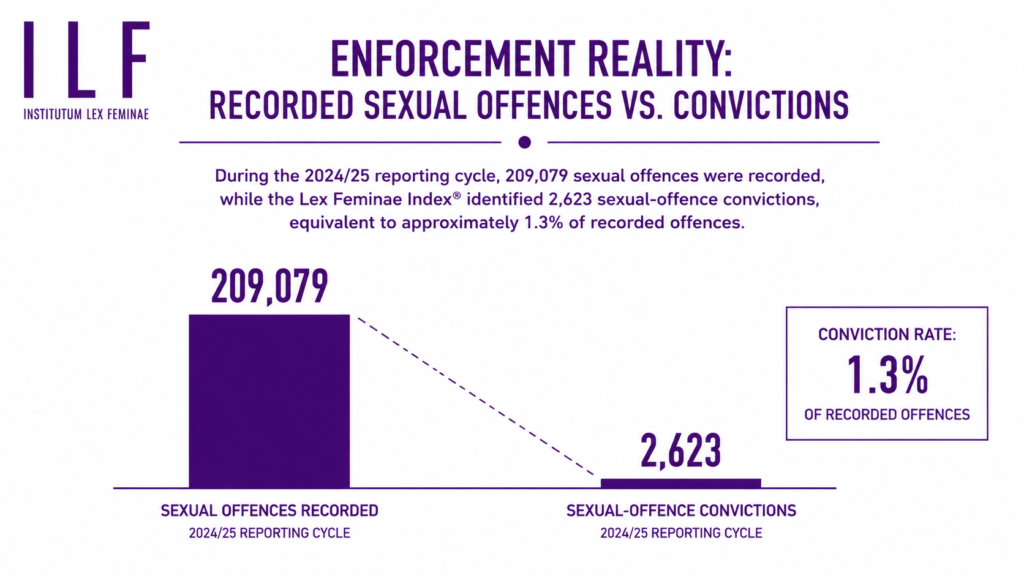
The report consequently characterised judicial throughput relative to intake as structurally narrow.
A CONVICTION IS NOT SYNONYMOUS WITH PROTECTION
Levy’s whole-life order is significant. It ensures that he cannot victimize another woman outside prison.
But the sentence arrived after two women were dead.
That distinction goes to the central question posed by the Lex Feminae Index® United Kingdom 2026 Edition:
Does enforcement practice produce measurable protection for women after violence occurs?
A criminal justice system performs several functions. Punishment is one. Incapacitation is another. Investigation, risk management, deterrence and protection are also components of enforcement.
A severe sentence at the end of the process cannot retroactively cure failures earlier in that process.
In Levy’s case, the relevant enforcement chain was not simply:Crime → Prosecution → Conviction → Whole-life sentence
It was substantially longer:
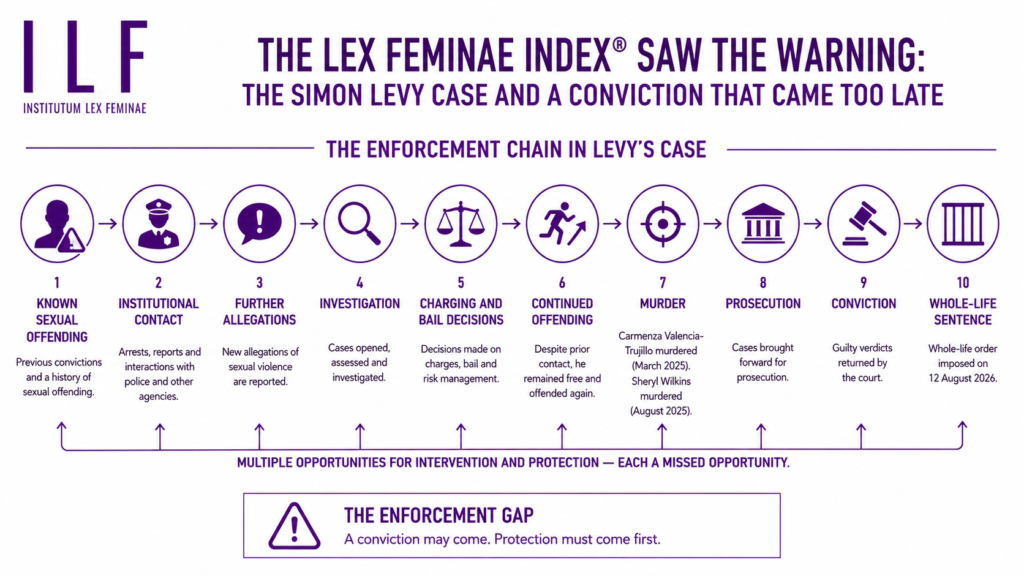
The critical analytical question lies in the middle of that chain.
Where did the opportunities for intervention disappear?
THE LEX FEMINAE INDEX® IDENTIFIED MORE THAN LOW CONVICTION CONVERSION
This is where the Levy case intersects particularly closely with the Lex Feminae Index® United Kingdom 2026 Edition.
The final assessment identified five structural weaknesses:
▫️ Conviction and custodial exposure were rare relative to recorded violence intake.
▫️ Protection reliability was not demonstrably robust.
▫️ Intake-to-sentence attrition was significant.
▫️ Recidivism remained measurable across core offence categories.
▫️ Enforcement traceability across the protection chain was incomplete.
Levy’s history touches several of those dimensions simultaneously.
FROM AGGREGATE DATA TO AN INDIVIDUAL CASE
The Lex Feminae Index® did not predict that Simon Levy would murder Carmenza Valencia-Trujillo or Sheryl Wilkins.
What it identified was something broader and more important for public policy: structural conditions under which recorded violence does not consistently translate into timely sanction and demonstrable protection.
The Lex Feminae Index® United Kingdom 2026 Edition concluded that enforcement institutions remained active and legally functional. Police intake and CPS charging systems operated. Convictions occurred. Serious offences attracted custodial sentences.
For precisely those reasons, the United Kingdom was not classified as systemic failure.
But the Lex Feminae Index® nevertheless assigned Grade E, Severe Enforcement Deficiency, because conviction remained rare relative to recorded violence, protection reliability could not be demonstrated as robust, and enforcement traceability remained incomplete.
The distinction is important.
A system does not need to collapse completely to fail individual women.
It can process thousands of cases, publish extensive statistics, impose lengthy sentences and maintain sophisticated criminal legislation while still containing enforcement gaps through which high-risk offenders continue to move.
Simon Levy is now imprisoned for life.
That is accountability.
But Carmenza Valencia-Trujillo and Sheryl Wilkins are dead.
That is also an enforcement outcome.