Papua New Guinea’s HPV vaccination rollout shows why women’s health policy should be measured through delivery and outcomes, not commitments alone.
Research & Commentary | Institutum Lex Feminae™ | August 2026
Public policy is often assessed at the point of announcement. A programme is adopted, funding is allocated, or a government establishes a new national strategy. But for women and girls, the more important question comes afterward: did the policy reach the people it was designed to protect?
Papua New Guinea’s expansion of HPV vaccination provides a useful example.
HPV vaccination is a well-established tool for preventing cervical cancer, a disease that disproportionately affects women in countries where vaccination, screening and treatment remain difficult to access.
The policy question, therefore, is no longer simply whether vaccination forms part of a national health strategy. It is whether implementation produces measurable population-level protection.
From policy commitment to measurable delivery
A vaccination programme creates an unusually clear implementation chain.
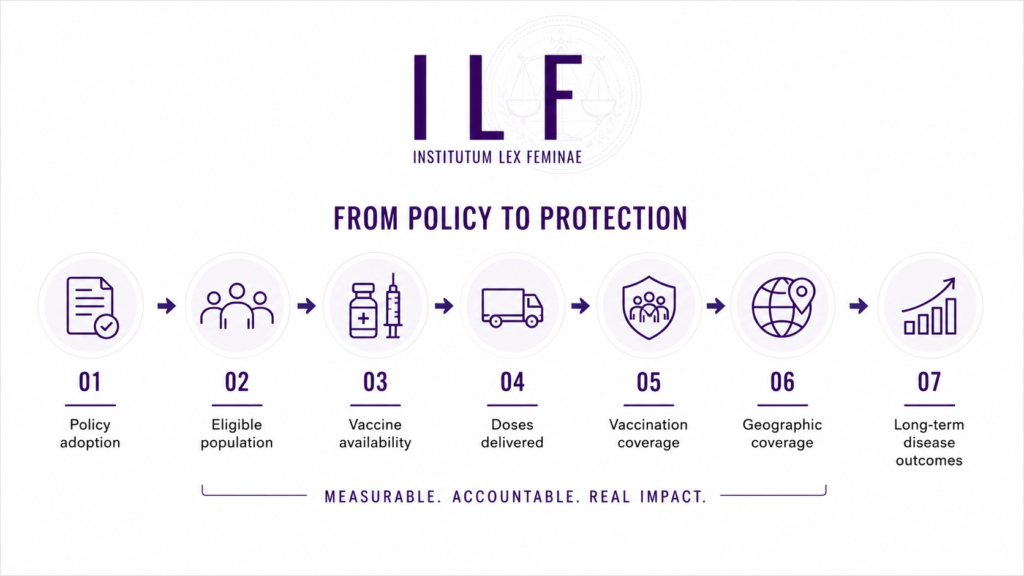
A government may formally provide access to HPV vaccination while significant gaps remain in vaccine supply, geographic distribution, public awareness or the ability of girls in rural and underserved communities to receive it.
For policy evaluation, the relevant measure is therefore not merely whether HPV vaccination is available in law or policy. It is how much of the intended population actually receives the protection.
WHY IMPLEMENTATION DATA MATTER FOR WOMEN’S RIGHTS
Women’s health policy frequently contains ambitious commitments whose practical effects are more difficult to establish.
Vaccination programmes provide an opportunity to move beyond that problem because implementation can be followed through concrete indicators.
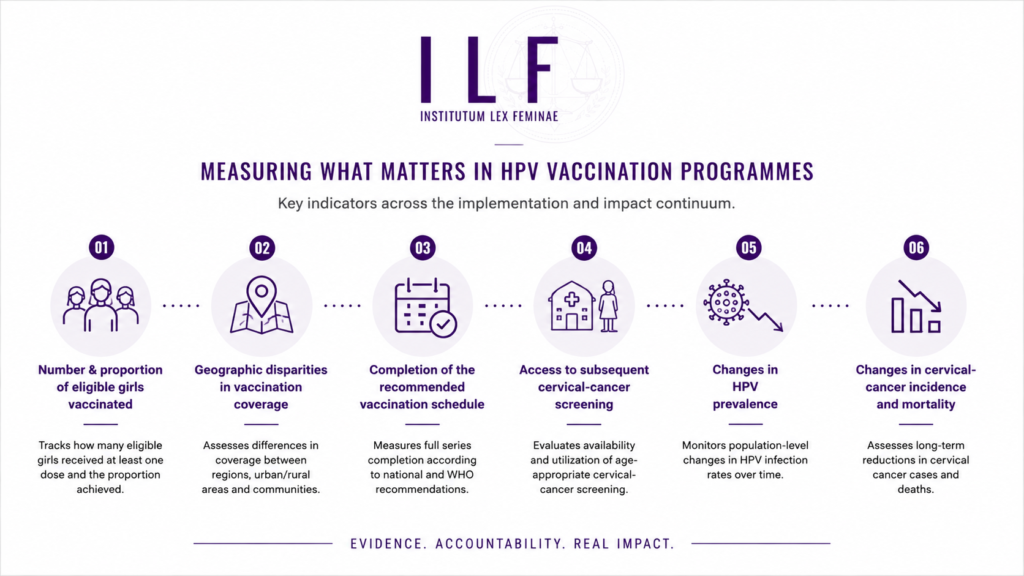
For HPV vaccination, those indicators can include:
The same principle applies more broadly to public policy affecting women.
A domestic-violence law can be measured through reporting, prosecution, protection orders and repeat offending.
A maternal-health programme can be measured through access, utilization and health outcomes. An employment-equality policy can be measured through participation, pay, promotion and retention.
The policy itself is the starting point. Implementation is where its effectiveness becomes visible.
AN ENFORCEMENT-AUDIT APPROACH TO PUBLIC HEALTH
Institutum Lex Feminae™ applies this distinction through an enforcement and implementation perspective.
Traditional policy analysis often asks whether a government has adopted the appropriate legal or policy framework.
An enforcement audit asks a second question: what happened after adoption?
Applied to HPV vaccination, that means moving beyond the existence of a national programme and examining whether implementation reaches the intended population consistently and equitably.
This approach does not presume failure. It creates a framework through which success can actually be demonstrated.
High vaccination coverage, equitable geographic distribution and declining cervical-cancer incidence would provide evidence that policy commitments are translating into measurable protection.
Persistent gaps would identify where implementation requires further intervention.
ALSO READ
- South Korea Gave a Telegram Sex Predator Life Yet The Law Still Struggled to Define His Network

- Pay Gap Reporting Is Not Employment Equality: What South Korea’s 29.3% Gap Reveals About Enforcement
- Age Gates Were Never Going to Protect Girls Online: What South Korea and the EU Reveal
THE BROADER LESSON
Papua New Guinea’s HPV programme illustrates a principle that extends far beyond vaccination.
Governments increasingly make commitments concerning women’s health, safety, economic participation and equality. Those commitments matter.
But their existence cannot, by itself, establish whether women’s lives have changed.
For research institutions, policymakers and civil society, the next stage of evaluation should therefore be increasingly empirical:
Who was supposed to benefit?
Who actually received the intervention? Where did implementation fail? And what measurable outcome followed?
That is the difference between documenting policy and measuring its effect.
For women’s rights, that distinction is critical.