ILF ANALYTICA | Governance & Equality | August 2026
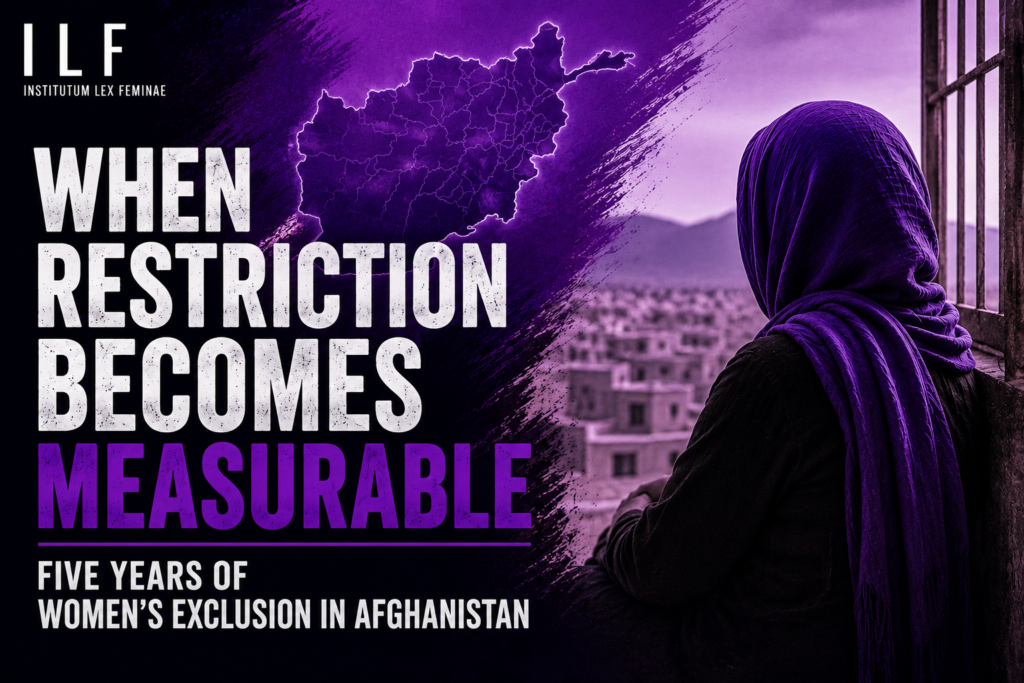
When Restriction Becomes Measurable: Five Years of Women’s Exclusion in Afghanistan
Five years after the Taliban returned to power in Afghanistan, the scale of restrictions imposed on women and girls is well documented. More than 100 decrees have targeted their rights and participation. Girls remain excluded from secondary education and women from universities. Restrictions extend across employment, movement and participation in public life.
But the latest evidence from UN Women provides something particularly important for policy analysis: a way to measure what those restrictions produce in everyday life.
Half of Afghan women interviewed now leave their homes no more than once or twice a month. Nearly three-quarters report feeling unsafe leaving home without a male guardian. Seven in ten describe their mental health as bad or very bad. Women’s employment stands at approximately 7%, compared with 84% for men.
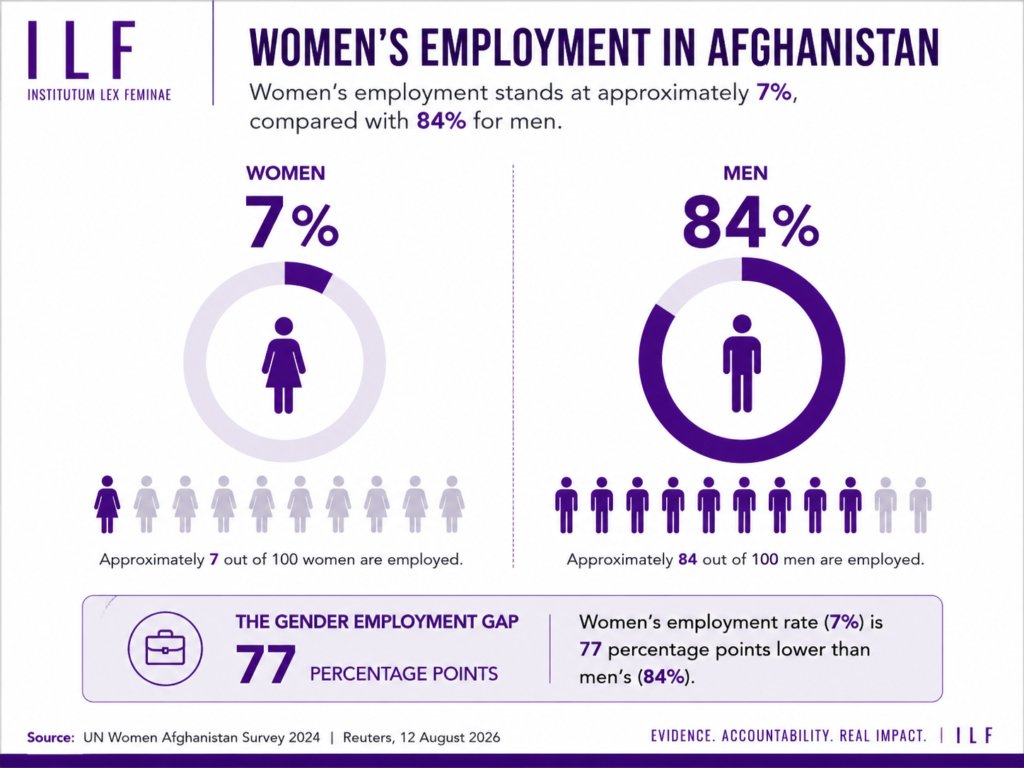
Women’s employment stands | Institutum Lex Feminae™
These figures move the analysis beyond documenting restrictions. They begin to quantify their implementation and effects.
FROM RESTRICTION TO OUTCOME
Legal and policy restrictions are often catalogued according to what they prohibit: education, employment, movement or participation in public institutions.
That tells us what a government has enacted. It does not necessarily tell us what those measures have produced.
Afghanistan increasingly allows both questions to be examined.
A restriction on women’s movement can be connected to actual mobility. Employment restrictions can be compared with labour-market participation.
Education prohibitions can be measured through exclusion from schools and universities. Restrictions affecting women’s independence can be examined alongside indicators of isolation and psychological well-being.
The resulting chain is measurable:
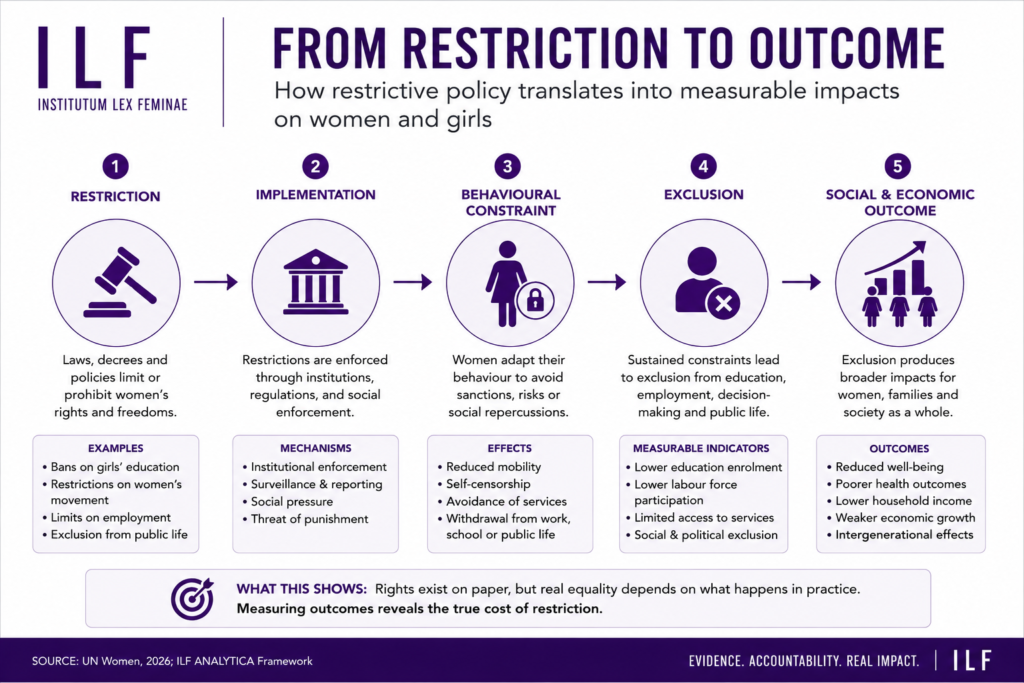
This distinction matters because implementation is where policy acquires its practical force.
MOBILITY IS BECOMING AN OUTCOME INDICATOR
Perhaps the most striking new measure is mobility.
More than half of the women surveyed by UN Women reported leaving home twice a month or less. Nearly 75% said they felt unsafe going out without a mahram, or male guardian.
These are not simply measures of attitudes toward government policy. They describe how frequently women are physically participating in society.
Mobility affects the ability to work, obtain healthcare, maintain social networks, pursue education, participate in civic life and exercise economic independence.
This makes women’s physical mobility a potentially important indicator when assessing systems that formally or practically constrain women’s movement.
The analytical question becomes not only what restrictions exist, but how much those restrictions alter women’s actual behaviour and access to public life.
EXCLUSION COMPOUNDS ACROSS INSTITUTIONS
The effects also cannot be examined independently.
Afghanistan remains the only country in which girls and women are formally prohibited from both secondary and higher education.
UNESCO estimates that 2.4 million Afghan girls have been barred from secondary education since the Taliban returned to power
Education exclusion therefore interacts with labour-market exclusion, while restrictions on mobility further constrain women’s ability to participate economically.
The long-term effects may extend beyond women themselves. UNESCO projects that restrictions on female education could contribute to a shortage of more than 11,000 qualified female teachers by 2030. It also estimates that the education bans could ultimately remove 600,000 women from the workforce by 2066 and produce $9.6 billion in cumulative lost income.
What begins as a restriction on individual rights can therefore develop into an institutional-capacity and economic problem.
MEASURING THE HUMAN CONSEQUENCES
UN Women’s findings also expose another dimension of implementation: psychological impact.
Seven in ten surveyed women described their mental health as either bad or very bad, with isolation, lost opportunities and reduced access to support networks among the reported factors.
Mental-health indicators require careful interpretation. They cannot establish that a particular decree independently caused a particular psychological outcome.
But when examined alongside severe restrictions on mobility, education, employment and social participation, they provide important evidence about the environment in which women are living.
This is why outcome measurement matters.
Counting laws or decrees tells researchers how extensively a regulatory system has changed. Measuring mobility, employment, education and well-being begins to show what that system means for the population subjected to it.
FROM DOCUMENTING RIGHTS TO MEASURING THEIR LOSS
Women’s rights can be weakened formally through legislation and decrees. They can also be weakened operationally through enforcement practices, institutional barriers and restrictions that make formally available rights increasingly difficult to exercise.
Effective policy analysis therefore requires more than identifying whether a right exists.
It requires asking:
- Can women exercise it?
- How frequently do they exercise it?
- What measurable outcomes follow when access disappears?
Five years after the Taliban takeover, Afghanistan demonstrates why those questions matter.
The international community already possesses extensive evidence that Afghan women’s rights have been restricted. The emerging data now allow researchers to measure something different: the degree to which those restrictions have reshaped women’s participation in society itself.
That is the point at which restriction becomes measurable.
Primary sources: UN Women: Five years after the Taliban takeover | Reuters: Half of Afghan women rarely leave home.
#Afghanistan #WomensRights #GenderEquality #HumanRights #InstitutumLexFeminae